Exhibitions
The permanent exhibition
Tuesday to Friday from 10am to 5:30pm, Saturday and Sunday from 10am to 7pm
Tuesday to Friday from 10am to 5:30pm, Saturday and Sunday from 10am to 7pm
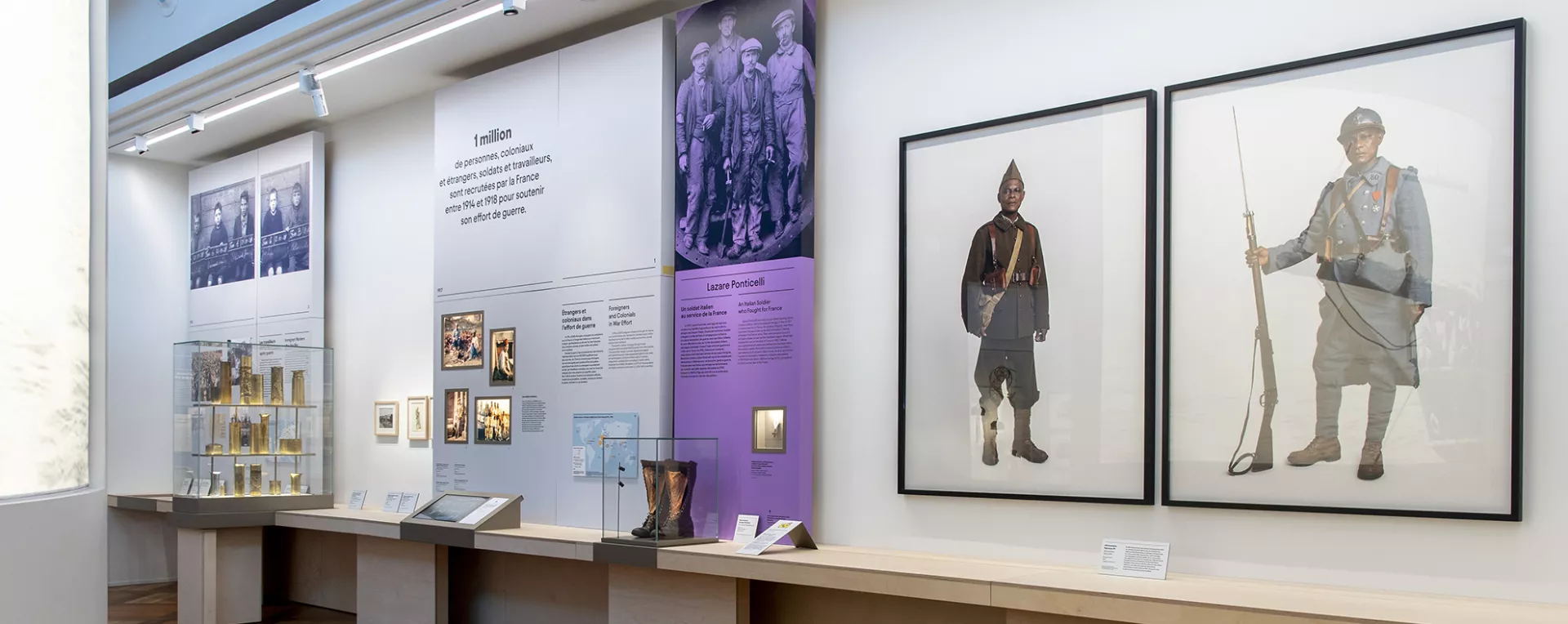
The permanent exhibition at the Musée national de l'histoire de l'immigration traces the history of France from 1685 to the present day through the lens of migration. Completely redesigned in 2023, it offers a chronological, thematic and sensitive overview of this shared history. Marked by eleven key dates, it concludes with a section devoted to contemporary issues.
The Musée's permanent exhibition covers three centuries of immigration history in France across 1,800 m². Archival documents, paintings, sculptures, photographs, contemporary creations and individual journeys: nearly 600 works and objects – from the museum's collections and on loan from several cultural institutions – tell another story of France, a story closely linked to the exchanges and movements of populations from 1685 to the present day.
Deeply connected to current events and contemporary issues, the permanent exhibition aims to make the history of immigration a central part of national history, to promote recognition of this history and, finally, to encourage reflection.

Section 1973 de l'exposition permanente du Musée.
Photo : Cyril Zannettacci © Palais de la Porte Dorée
These key dates, which mark the different chronological sections, provide an opportunity to tell a new story of immigration in France – political, economic and cultural. Identity papers, photographs, personal items and administrative documents, donated by immigrants or their relatives, retrace unique destinies that sensitively illustrate the upheavals of history.
Ponctué d’œuvres contemporaines, le parcours offre en outre une approche réflexive, esthétique et émotionnelle des migrations.
Parmi les artistes présentés, Kader Attia, Babi Badalov, Lahouari Mohammed Bakir, Pascale Consigny, Claire Fontaine, Samuel Fosso, Mathieu Pernot, Zineb Sedira, Barthelemy Toguo, Gaëlle Choisne ou encore Valérie Mréjen viennent éclairer de leur regard et de leur histoire personnels, les notions de circulation, d’exil ou d’identité.

Salle d'exposition du Musée national de l'histoire de l'immigration
Photo : Anne Volery © Palais de la Porte Dorée, 2024
Sébastien Gökalp
Head curator, director, Musée national de l’histoire de l’immigration.
Émilie Gandon
Executive curator, heritage curator, Musée national de l’histoire de l’immigration.
Marianne Amar
Scientific curator, dierctor of the research department at the Musée national de l’histoire de l’immigration.
Emmanuel Blanchard
Scientific curator, historian and political scientist, lecturer at the Université de Versailles- Saint-Quentin and lecturer / researcher at Sciences Po Saint-Germain-en-Laye.
Delphine Diaz
Scientific curator, historian, lecturer in contemporary
history at the University of Reims Champagne-
Ardenne, junior member of the Institut Universitaire
de France.
Camille Schmoll
Scientific curator, geographer, director of studies at EHESS/ Géographie - cités laboratory.
L’exposition permanente du Musée sera fermée au public jusqu'au printemps 2023. Pendant cette période, les espaces seront en travaux pour assurer un meilleur renouvellement de l’air et pour repenser toute la scénographie du Musée.
Le parcours permanent proposait jusqu’à présent une approche thématique (l’expérience de l’immigration, la confrontation avec l’Etat et l’opinion publique, les lieux de vie, le travail, la diversité culturelle,...). Il sera en 2023 conçu selon une approche historique centrée sur dix grandes dates, de 1789 à 2015, avec une dernière section consacrée aux questions contemporaines. De nouveaux outils numériques et un parcours réservé aux enfants seront également proposés.
Cette refonte muséographique s’appuie sur le rapport de préfiguration du comité scientifique présidé par l’historien Patrick Boucheron. Elle nécessite au préalable de transformer certains espaces. Il est prévu notamment d’améliorer le parcours de visite pour qu’il devienne circulaire, et ainsi remédier au défaut actuel d’une galerie en cul-de-sac, grâce à l’intégration d’un espace occupé jusqu’à présent par des bureaux administratifs. Les travaux permettront aussi un plus grand renouvellement des œuvres. Les dons, auparavant regroupées dans la Galerie des dons, seront intégrées à l’exposition permanente. La rénovation des espaces s’accompagnera, enfin, de leur sonorisation, permettant la diffusion d’annonces au public, et d’une mise aux normes d’accessibilité.
L’Établissement a commandé en 2018 une étude thermique et climatique. Celle-ci a mis en évidence des améliorations possibles de l’hygrométrie (taux d’humidité dans l’air) qui doit être stable pour la bonne conservation des œuvres d’art, dans les galeries des expositions temporaires et le parcours permanent. Ces travaux consistent à remplacer les centrales de traitement de l’air (CTA) existantes et à en installer de nouvelles dans les espaces qui en sont dépourvus. Les CTA sont situées en toiture, avec des gaines d’aération à installer dans les espaces du dernier étage.
Le parcours permanent du Musée sera fermé jusqu'au printemps 2023, mais le Musée proposera dès le 9 mars 2021 une exposition d’art contemporain dans le cadre de la saison Africa2020, puis du 4 novembre 2021 au 13 février 2022, l’exposition Picasso l’étranger, qui portera un nouveau regard sur l’artiste, centré autour de son statut d’étranger en France..
Réouverture des galeries permanentes au printemps 2023.
Expositions temporaires :


